Thursday, January 28, 2010

Kelebihan Si Kidal

copy jak tok..nak madah aku tok kidal bah..hahaha....so baca la..spa2 nk kidal ya...hahaha


Definisi

Kidal bermaksud individu yang lebih cenderung menggunakan tangan kiri untuk. melakukan berbagai tugasan. 10 peratus dari 6.7 billion populasi di dunia ini adalah manusia yang kidal ( lefthanded ). Hubungan kidal dengan otak Secara amnya kidal juga bermaksud lebih menguasai otak di sebelah kanan. Ini adalah kerana otak kita berfungsi secara menyongsang iaitu otak sebelah kiri menguasai bahagian tubuh badan yg. di sebelah kanan dan otak sebelah kanan pula menguasai bahagian tubuh badan yg. di sebelah kiri. Otak sebelah kiri (cenderung menggunakan tangan kanan) menguasai kawalan pertuturan, bahasa, tulisan, lojik, matematik dan sains. Otak sebelah kanan (cenderung menggunakan tangan kiri) menguasai kawalan muzik, seni, kreativiti, tanggapan, emosi dan kebijaksanaan.Dengan penguasaan otak ini adalah dikatakan individu kidal lebih bijak dari segi kreativiti dan seni berbanding mereka yg. menggunakan tangan kanan.
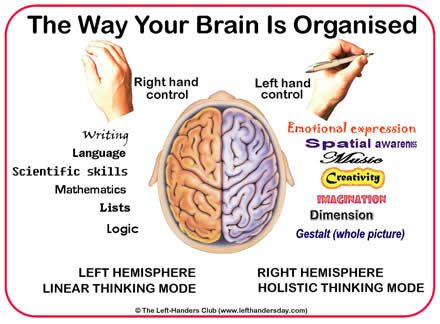
brainorg

Hubungan kidal dengan otak

Secara amnya kidal juga bermaksud lebih menguasai otak di sebelah kanan. Ini adalah kerana otak kita berfungsi secara menyongsang iaitu otak sebelah kiri menguasai bahagian tubuh badan yg. di sebelah kanan dan otak sebelah kanan pula menguasai bahagian tubuh badan yg. di sebelah kiri.

Otak sebelah kiri (cenderung menggunakan tangan kanan) menguasai kawalan pertuturan, bahasa, tulisan, lojik, matematik dan sains.

Otak sebelah kanan (cenderung menggunakan tangan kiri) menguasai kawalan muzik, seni, kreativiti, tanggapan, emosi dan kebijaksanaan.Dengan penguasaan otak ini adalah dikatakan individu kidal lebih bijak dari segi kreativiti dan seni berbanding mereka yg. menggunakan tangan kanan.

Fakta menarik

1. Individu kidal cenderung merasa cemas ataupun malu dengan apa yang ingin dilakukan atau dikatakan.

Kajian dari Abertay University Skotlandia menemukan bahwa orang kidal cenderung lebih setuju dengan pernyataan seperti : “Saya khautir membuat kesalahan.” Mereka yang kidal juga sepakat dengan penyataan : “Kritik atau omelan membuat saya sedikit sakit hati.”. Dr Lynn Wright, yang menjalan kajian tersebut di Dundee, Skotlandia, percaya fenomena ini disebabkan adanya perbezaan bahagian otak antara orang kidal dan orang tangan kanan.

“Orang kidal cenderung lebih bimbang, sedangkan mereka yang memakai tangan kanan cenderung sedikit bergerak cepat. Pada orang kidal, bagian otak kanannya lebih dominan, dan inilah bagian yang sepertinya mengendalikan aspek negatif dari emosi. Mereka yang lebih banyak memakai tangan kanan, bagian otak kirinya lebih dominan,” jelas Lynn

TOKOH-TOKOH KIDAL

1. Presiden Amerika Syarikat

I. James A. Garfield (1831-1881) 20th

II. Herbert Hoover (1874-1964) 31st

III. Harry S. Truman (1884-1972) 33rd

IV. Gerald Ford (1913- ) 38th

V. Ronald Reagan (1911 – ) 40th

VI. George H.W. Bush (1924- ) 41st

VII. Bill Clinton (1946- ) 42nd

VIII. Barrack Obama 44th ( Mccain juga seorang kidal )

2. Tokoh ternama

v Aristotle (Ahli falsafah)

v Mahatma Gandhi (tokoh keamanan),

v Isaac Newton (saintis)

v Albert Einstein (saintis)

v Henry Ford Jr., (automobil)

KELEBIHAN DAN KEKURANGAN

1. Kesukaran bagi individu kidal:

Menulis didalam buku tebal (diari, buku laporan,dll ) akan menyukarkan individu kidal semasa menulis di bahagian kiri mukasurat kanan buku.Tulisan yang bermula dari kiri ke kanan juga merupakan salah satu faktor individu kidal menulis dengan gaya/cara yang unik sedikit.

Penggunaan peralatan lain tangan kanan; Gunting, senjata api (machine gun, alatan memanah, dll ), komputer (tetikus), peralatan dapur, dan lain-lain.

Kerusi meja (kerusi kuliah) ; Penggunaan meja kerusi meja di dalam kelas dicipta khusus untuk orang tangan kanan. Maka, individu yang kidal perlu mengiringkan sedikit badan sewaktu menulis agar tangan kidal dapat memanfaatkan setiap ruang meja yang ada.

Individu kidal dipercayai mempunyai kelemahan dalam aspek:

* Pengurusan
* Kesihatan
* Pendidikan
* Kerjarumah/surirumah
* Pelajar

2. Kelebihan bagi individu kidal:

Tulisan Arab:

· Menulis dalam tulisan jawi/arab lebih senang berbanding tulisan biasa.

Kreativiti:

· Individu kidal menggunakan otak sebelah kanan yang menguasai kawalan muzik, seni, kreativiti, tanggapan, emosi dan kebijaksanaan.

Kamera :

· Bentuk kamera SLR yang memerlukan kedua-dua belah tangan sedikit menyenangkan individu kidal. Tangan kidal/kiri akan digunakan untuk memegang lensa dan menyokong berat kamera tersebut. Oleh itu, mereka lebih cepat mengubah fokus kamera dan kamera dapat disokong dengan mudah.

“Adaptability:

· Because their world is dominated by right-handed products, lefties are much more easily adaptable to right-handed tools and utensils than righties are to left-handed products. This can be helpful if a lefty breaks his dominant arm and is temporarily unable to use it.”

Peperangan :

· Sewaktu peperangan zaman lampau,apabila dua individu bertemu,mereka akan saling memegang tangan kanan antara satu sama lain. Ini akan menunjukkan mereka tidak membawa senjata. Individu kidal sahaja yang dapat mengambil kesempatan memegang pedang di belakangnya.

· Kebanyakan pahlawan kidal terpaksa berlatih pedang dengan pahlawan tangan kanan. Oleh itu, mereka bersedia bertempur dengan pahlawan tangan kanan manakala majoriti pahlawan tangan kanan tiada persediaan menentang pahlawan kidal.

Individu kidal dipercayai mempunyai kelebihan dalam aspek:

a) Teknologi Maklumat

Bill Gates

b) Seni ( suara, lukis, pertahanan diri/peperangan )

Saidina Umar Al-Khattab

Julius Caesar,

Alexander the Great,

Napoleon Bonaparte dan Isterinya,

Leonardo Da Vinci

c) Musik dan hiburan

Michelangelo Buonaroti,

Beethoven

Selebriti

Oprah Winfrey

Amitabh Bachchan

Tom Cruise

Charlie Chaplin

Nicole Kidman

Marilyn Monroe

Angelina Jolie

Keanu Reeves

Sylvester Stallone

Asmawi bin Ani( Mawi )

Man Kidal

d) Sukan

Pelé -Edson Arantes do Nascimento (Bolasepak)

Diego Armando Maradona (Bolasepak)

Lieonel Messi (Bolasepak)

Rafael Nadal (Tenis)

John McEnro (Tenis)

Lin Dan (Badminton)

Valentino Rossi (Lumba motosikal)

Rumusan

1. Secara kasarnya sekitar 10-15% drp. penduduk dunia adalah kidal.

2. Orang kidal tidak semestinya mempunyai kedua ibubapa yg. juga kidal.

3. Menurut kajian tidak ada sesiapapun yg. dpt. mendefinasikan mengapa sesetengah individu itu dilahirkan kidal. Tidak ada gen yg. mengaitkan orang kidal dpt. dikenalpasti, tetapi ianya mempunyai kaitan didalam sesebuah keluarga.

4. Leonardo da Vinci menulis kesemua data peribadinya dari kanan ke kiri (seperti penulisan jawi) sehinggakan sesiapa yg. ingin membacanya terpaksa menggunakan cermin utk. menterjemahkan mesej-mesejnya.

5. Hari istimewa utk. orang kidal adalah Hari Kidal Sedunia yg. disambut pada 13 Ogos setiap tahun.(ni budaya orang barat-tak perlu ikut..huhu)

6. Lebih ramai lelaki yang kidal berbanding perempuan

7. Individu Kidal, Individu Elastik

Disebabkan individu kidal terpaksa menggunakan pelbagai barangan untuk orang biasa (tangan kanan), mereka terpaksa menyesuaikan diri dalam semua keadaan agar dapat menggunakan sesuatu kemudahan seperti orang bertangan kanan. Akhirnya, mereka dapat menyesuaikan diri dalam semua kerja walaupun dengan gaya kerja yang sedikit berbeza. Dan disebabkan itu juga menjadi faktor orang kidal hidup 9 tahun lebih pendek dari orang dengan tangan kanan secara puratanya.

Orang kidal pintar?

Memang ramai individu kidal yang tersohor tetapi kepintaran mereka bukan kerana kidal tetapi kerana mereka menggunakan 80%-90% otak. Mengikut pendapat aku, individu kidal bukan sahaja menggunakan otak kanan secara maksima,tetapi juga menggunakan otak kiri lebih banyak dari orang biasa yang menggunakan otak kanannya. Orang kidal menggunakan lebih banyak bahagian otak kerana secara ringkasnya mereka juga melakukan beberapa kerja menggunakan tangan kanan selain menggunakan tangan kiri mereka dan secara automatik mereka menggunakan kedua-dua belah bahagian otak lebih dari orang kebiasaan. Bukan semua kidal tu pandai tapi yang pasti, tak kira kidal atau tidak, kalau malas buat kerja.

Makan tangan kiri

Rasulullah saw bersabda, “Wahai anak, bacalah nama Allah dan makanlah dengan tangan kananmu, dan makanlah seterusnya dengan tangan kananmu.” (HR. Bukhori Muslim)

Pasal isu makan guna tangan kiri. Aku rasa ramai kidal pun makan dengan tangan kanan kecuali kalau guna sudu kan? Orang kidal ni selalu kena tegur kalau makan guna sudu. So, bagi orang kidal, makan la guna tangan je. Ikut sunah Nabi, dapat pahala lagi.


Sunday, January 24, 2010

Improve Your Photos 60 Seconds at a Time

If you are tired of reading long explanations and confused by tricky photo techniques, here you can have it short and sweet. Arranged by topics, each subject takes less than 60 seconds to read.

Once you’ve read the ideas and tips, picture in your mind some photographs you have already taken. Think of how they could have been improved by applying what you have learned here. Visualize how you might have taken your photos differently. Already your photography is improving!


Light

Dancing with light

Dancing with the light

  • Light from the side brings out shapes, textures and structures. That’s why early morning and evening are rich times to photograph.
  • With the sun behind your subject, you get some of the most dramatic visual effects … but exposure could be tricky to get right. Try it anyway!
  • When the sun is high and the light is hard, don’t fight it to try to get it all. Concentrate on exposing the bright parts properly and work with the shapes of shadows.
  • For light and shadow effects you need the sun, of course, but colours are often more intense on half-sunny or overcast days.

The color of color

Colour of colour

  • Natural light is white, while artificial light is often shades of yellow, orange or green.
  • Our eyes naturally adjust to colored or tinted light sources to make them appear white and so will your digital camera but only within certain limits
  • If you want warm-colored pictures work earlier or later in the day when natural light tends to be more orange.
  • This image shows warm light from an evening sun but bluish shadows from the cloudless sky

Mastering flash

Mastering Flash

  • Balance the flash with day light for stunning results. Your camera may offer a ’slow flash’ or ’synchro flash’ or ‘daylight synchro’ setting.
  • Direct flash on groups of people produces better-looking images than direct flash on a single person.
  • The latest cameras allow you to set high ISO speeds e.g. ISO 800 which can help avoid using flash altogether.
  • Avoid red-eye by turning up or providing more light in the room.
  • If you use your camera’s red-eye reduction setting when taking flash photographs of people you avoid red-eye, but there’s a delay in taking the shot which may cause you to miss the moment.

Choosing your time

Choosing your time

  • Low or cross lighting at dawn or dusk produces wonderful lighting and colors.
  • At dawn and dusk there are natural shadows to help give depth and form to your subject.
  • For early evening shots, you will need longer shutter times i.e. longer exposure to make up for the low light. This makes it likely your photographs could be blurry due to camera shake, so lean your camera on something - anything steady - to keep still during exposure.
  • Don’t be afraid to point the lens at a setting sun , but whatever you do avoid looking at the sun directly, especially through the viewfinder of your camera.

Landscaping your photos

Composition essentials

Composition essentials

  • It’s best to keep your horizons level in your photographs, otherwise your shots will appear crooked (unless that’s what you want!).
  • Keep the main points of interest away from the centre, and from the extreme edges - better, still, try placing them in different parts of the image and see which works best.
  • Don’t shoot everything from a standing position. Look for unusual angles by changing yours (and the camera’s position).
  • Better to avoid completely empty space in your photos.

Framing the lines

Framing the lines

  • Don’t be afraid to use take portrait photographs - that is, with the camera on its side.
  • Use natural features in the environment to create a frame for your subject or to lead the eye through the image.
  • Zoom in to create a sense of intimacy. Remove from your shots elements like the sun or the sky, which give a feeling of open space.
  • Experiment with framing. Try framing your shots with lots of foreground and very little sky, or lots of sky and very little land.

Zooming around

zooming around

  • Zooming-out allows you to capture more of the view.
  • A wide-angle lens will keep everything in focus while helping to maximise the ‘depth of field’, or feeling of depth in your shots.
  • Zooming-in will flatten the sense of perspective and make distant objects appear closer together.
  • Zooming-in will also affect the amount of your picture that is in focus allowing you to isolate details against an out-of-focus foreground and/or background.
  • Be careful to avoid camera shake when zoomed right in, as tiny movements in your hands become magnified.

Prospecting the perspective

Perspective

  • Create perspective by using the lines and shapes within the shot to draw the eye.
  • Tall buildings can appear to ‘lean back’ when photographed. Getting something in the foreground of your shot helps balance this.
  • Increase the sense of perspective by using a wide-angle lens and adding foreground interest.
  • A low viewpoint and wide-angle setting helps to contrast the size and shape of objects in interesting ways.

Foregrounding

Foreground

  • Foreground is the area that is closest to the camera: the stronger it is, the stronger the rest of the image.
  • An object in the foreground first invites the eye, then lead the viewer deeper into the photo.
  • Include foreground objects to add a sense of scale and perspective
  • Experiment with allowing the foreground to totally dominate the photo

Cool proportions

Cool proportions

  • The central part of your scene usually draws the camera like a magnet so it ends up in the centre - try resisting that tendency
  • Place the main point of interest towards the sides of your photographs for more dynamic compositions
  • Place your horizon near the top or bottom of your shots to add emphasis to the ground or to the sky
  • In this picture you can see there is a smallish amount of sky while the rocks have been placed high in the image to allow the silhouette of the trees to be significant.

People with you

Lighting faces

Lighting faces

  • The soft light you get on overcast days is especially good for photographing people, as it delivers the best skin tones
  • Side or ‘cross’ lighting is more interesting because it gives depth and form to your portrait sitter
  • Keep backgrounds and other distractions to the minimum so that the viewer can concentrate on the face
  • In this picture, soft light from a window lights the faces of the girls from the side, while a zoomed-in setting throws the foreground face out of focus.

Depth of feeling

Depth of feeling

  • Use your zoom lens to shorten the ‘depth of field’ (depth sharpness) in your photograph, and throw the background out of focus. This adds emphasis to your subject.
  • Use your zoom lens to fill your photograph, rather than leaving your main point of interest floating in space.
  • Zooming in will flatten perspective, which generally produces a more flattering shot of your subject.
  • In this picture, a zoomed-in setting focuses on the girl, throwing the foreground objects out of focus.

Natural frames

Natural frame

  • Use a person’s surroundings to be a natural picture frame the photo
  • People will often smile and pose stiffly for their portrait: if you don’t want a smile take two or more pictures - a second or two after a smile, the pose relaxes and you have a more natural shot.
  • Look for the natural junctions of the human body (where it seems natural to ‘cut-off’) if you are not including the whole person in the shot.
  • Soft light is easiest to work with: try sitting your subject near a window.

Childish tricks

Childish tricks

  • Get the children used to you and the camera by firing off lots of shots first.
  • For small children , pre-focus the camera. This is done on most digital cameras by pressing down halfway on the shutter button. Then move yourself backwards and forwards with the child to keep the shot in focus.
  • Get down on your hands and knees to stay level with your subject and appear less intimidating.
  • Use something to draw the child’s attention away from the fact that they are having their photograph taken.

Coloring the essentials

Bolder colors

Bolder colours

  • Redder colors will create a warmer feel for your shots than blues or greens.
  • color affects the way we look at pictures, so try to use color creatively in your shots.
  • Look for images that contain contrasting colors, such as red and green or yellow and purple, to add tension or drama.
  • Using shades of the same colors will create a sense of harmony.

The best light is free

Free light

  • Bright sunlight gives colors a more intense or ’saturated’ feel.
  • Midday light has a bluer quality, which can give photos a harsher feel.
  • Try to place strong colors against large areas of even tone or color - this helps bring out their intensity
  • Look for color contrasts - red with blues and greens, for example.
  • Photographs taken at the beginning or end of the day will have a warmer tone due to the natural orangeness of the light.

Emotional colors

Emotional colors

  • Different dominant colors lead your viewer towards different emotions which impacts on the way your shot is experienced
  • Yellow is associated with happiness, but orange may moves us toward concern - hence the use of amber as a warning light.
  • Red is the universal color of warning. Use it with caution - a little bit of red in your shot goes a long way!
  • Greens and blues usually have a calming effect, hence their association with landscape
  • The many colors in this shot are held together by the large areas of yellows, giving it an unmistakeable sunny Mediterranean mood.

Composition

Lines of force

Lines of force

  • You can create a sense of direction using naturally occurring lines.
  • Slanting or ‘oblique’ lines imply movement, action and change.
  • Curved lines or S-shaped lines imply quiet, calm and sensual feelings.
  • Lines that converge imply depth, scale and distance, for example, the outer edges of a road converge as it disappears into the distance, giving a two-dimension image three-dimensional depth.
  • Repetitive elements create a sense of rhythm, which is often more interesting if the rhythm is broken by a missed element.

Thirds

rule of thirds

  • Imagine two horizontal and two vertical lines equally dividing your shot, then place subjects on the lines or where they intersect with each other: this can be a help in deciding on compositions
  • Place your horizon on the top or bottom line to add emphasis to the ground or to the sky respectively.
  • In this picture, the composition combines color contrasts with proportions closer to another principle, the Golden Section, which gives pleasing proportions.
  • Just pushing your composition slightly to one side so it feels a little uncomfortable can give your photos a dynamic it wouldn’t otherwise have.

Focusing away

Focusing away

  • The human eye is drawn to elements that are in focus, and this will influence how your photo is seen.
  • Auto-focus (standard on most digital cameras) will focus on what is in the centre of the frame. Use pre-focus to move your subject away from the centre of the frame. (This is done on most digital cameras by pressing down halfway on the shutter button.)
  • Use your zoom lens to reduce the ‘depth of field’ (sense of depth) and throw the background out of focus. This will emphasise any in-focus element in the foreground.
    Photo © Wendy Ang

Being ready

Drive your motor

Drive your motor

  • Take lots of pictures. With digital cameras shots cost you hardly anything at all.
  • Move around as you photograph to experiment and give yourself plenty of choice later.
  • Stay alert for that chance-of-a-lifetime shot: keep your camera turned ON, keep your mind switched to ON.
  • In this picture, the golden eagle put its wing on the falconer for only a few very short seconds, and the falconer grinned for even less time!

Vantage points

Vantage points

  • It is almost always worth clambering up a wall or steps to get a little higher - but don’t get yourself into trouble with authorities.
  • You may also have to wait for the best light.
  • And you might have to wait for a composition of passing people to arrange itself
  • The best position may depend on the zoom setting that you choose.
  • In this picture, I had to wait nearly thirty minutes for everyone to get themselves into position.

Shutter lag

Shutter lag

  • Shutter lag is the time a digital camera needs to capture a picture after you have pressed the shutter button.
  • Reduce shutter lag by focusing beforehand, hold the shutter button down half-way or half-pressure and wait for the moment.
  • Reduce shutter lag by turning off any unnecessary automatic features such as red-eye reduction.
  • In this picture, the only way to catch the air force jets at the right instant was to release the shutter just before they reached their ideal positions.

Always ready

Always ready

  • If you see a good picture you may be early: an even better one may come in a few seconds
  • Get your exposure and focusing and framing set up while you wait for the perfect shot
  • Hold the camera to your eye all the time; in the half-second it takes lift the camera you could miss the shot
  • In this picture, I spotted the shepherd from a car, screeched/skidded to a halt, got the car to disappear and waited for the flock to approach me - using the time to work out the best viewpoint to meet them.
  • copy at http://www.idigitalphoto.com/improve-your-photos/